

Resources
for You and Your Team

Behavioral HealthTech in 2026: AI Risk, FDA Boundaries, and Unlocking DMHT & RTM Reimbursement
Behavioral HealthTech is entering a new era of AI regulation, patient-safety obligations, and digital health reimbursement. Explore FDA/SaMD boundaries, AI risk governance, FTC health-data privacy, DMHT and RTM billing pathways, and the key diligence issues boards, founders, and investors should address in 2026.
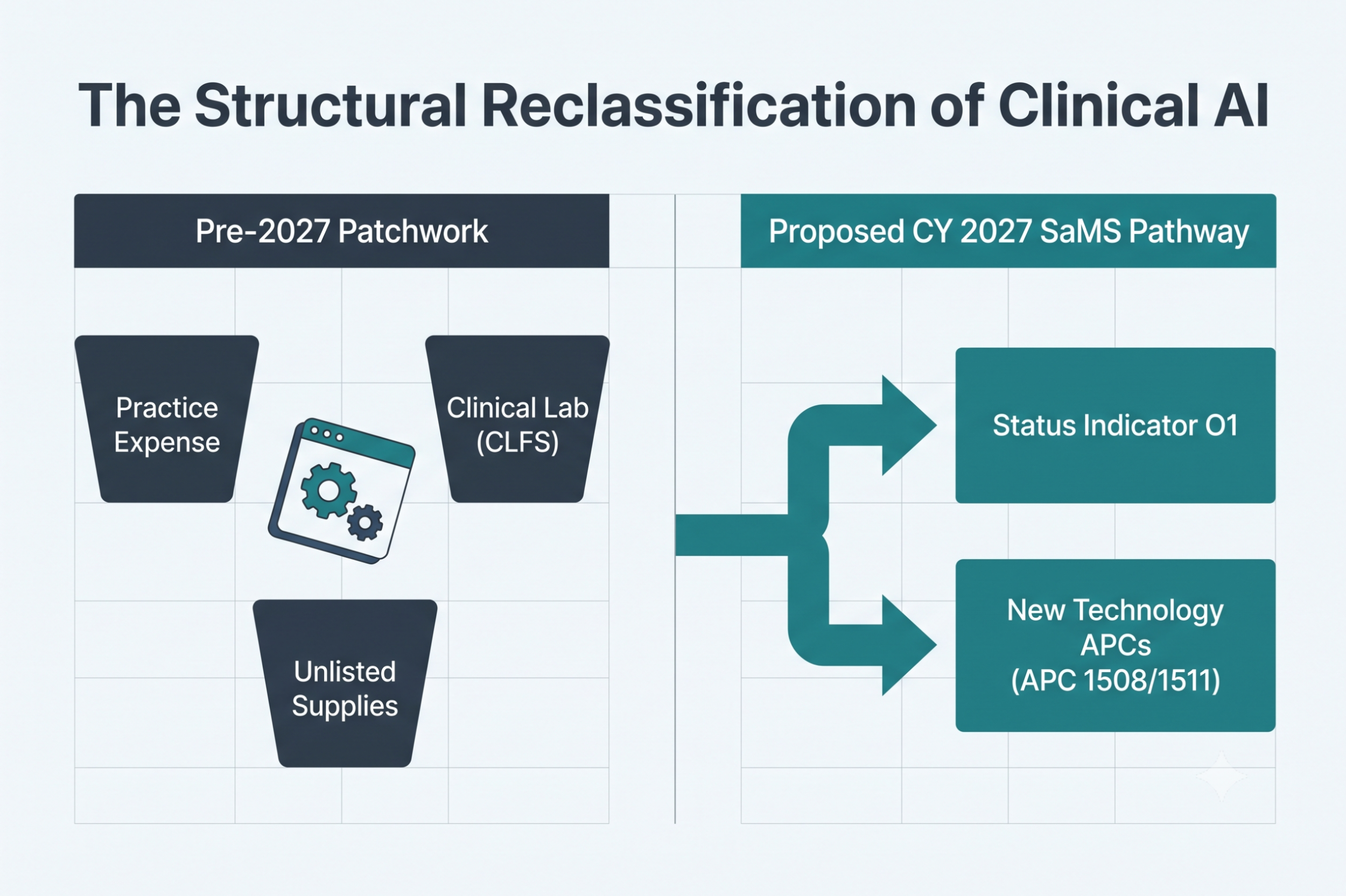
What is Software as a Medical Service (SaMS) under the 2027 OPPS Proposed Rule?
The CMS CY 2027 OPPS Proposed Rule introduces Software as a Medical Service (SaMS), a proposed Medicare reimbursement pathway for qualifying clinical AI and software-based medical technologies. Learn how the new O1 Status Indicator, New Technology APC payments, and updated reimbursement policies could reshape commercialization strategies for digital health companies, healthcare providers, and investors.

What Does the CY 2027 Medicare Physician Fee Schedule Proposed Rule Mean for Digital Health Companies?
CMS's 2027 Medicare Physician Fee Schedule proposed rule introduces sweeping changes for digital health, telehealth platforms, AI-enabled care, remote patient monitoring (RPM), remote therapeutic monitoring (RTM), software-based medical services, interoperability, and physician reimbursement. This comprehensive analysis explains the proposed BB/BC telehealth modifiers, the potential end of third-party RPM staffing models, CMS's new Software as a Medical Service (SaMS) framework, AI-focused requests for information, and the opportunities for digital health companies to influence the final rule before comments close on September 14, 2026.

When does AI Health Software Become an FDA Regulated Medical Device? Lessons from WHOOP and UpDoc
Does adding AI to healthcare software automatically trigger FDA regulation? Not necessarily. This article examines the FDA's 2026 WHOOP closeout letter and UpDoc's 510(k) clearance to explain how the agency evaluates AI-enabled digital health products based on intended use, clinical risk, software functionality, user interface design, and validation—not simply the use of artificial intelligence. HealthTech founders, software developers, investors, and regulatory professionals will gain practical guidance on FDA General Wellness enforcement discretion, Software as a Medical Device (SaMD), AI governance, and product design strategies that can influence whether software remains a wellness product or becomes an FDA-regulated medical device.

Does Every Digital Health Company Need a Health Tech Lawyer?
Can AI or a general business attorney handle legal and regulatory issues for your digital health company? In this article, Carrie Nixon explains why health tech startups, telehealth companies, and digital health platforms face unique risks involving HIPAA, Corporate Practice of Medicine (CPOM), Stark Law, Anti-Kickback Statute compliance, healthcare data privacy, reimbursement structures, and AI governance. Learn where AI tools can help health tech founders—and where experienced healthcare legal counsel is essential.

The 2026 Guide to Healthcare Generative AI Regulations: Frameworks and Compliance for Leaders
Healthcare generative AI has entered a new regulatory era in 2026. This guide breaks down the core framework leaders need to understand—from FDA medical device rules and HIPAA obligations to FTC enforcement and fast-evolving state laws. Learn how key design choices—such as generative vs rules-based AI, chatbots vs autonomous agents, and clinical vs administrative use—directly shape compliance requirements, risk exposure, and go-to-market strategy.

Legal as a Go-To-Market Strategy for Healthcare AI Companies
In 2026, leading Healthcare AI companies are transforming legal and regulatory strategy into a powerful go-to-market lever. From state-level regulatory sandboxes to evolving FDA Clinical Decision Support (CDS) guidance and CMMI reimbursement models, this post explores how companies can accelerate market entry, generate real-world evidence, and build a durable competitive moat.

National Privacy Day: A Data Privacy Check-In for Digital Health and Wellness Companies
Is your digital health privacy strategy keeping pace with your technology? On National Privacy Day, we explore why privacy is a core business driver for telehealth, AI, and RPM innovators. From navigating the intersection of HIPAA and state consumer health laws to managing AI data governance and FDA cybersecurity, discover the five critical questions every healthcare leader must answer to ensure compliance, investor confidence, and long-term scalability.

FDA Advisory Committee Signals New Regulatory Expectations for Generative AI in Digital Mental Health: What Innovators Need to Know Now
On November 6, 2025, the FDA’s Digital Health Advisory Committee delivered a clear message to the generative AI DMH sector: expect greater structure and tighter oversight. This article breaks down the 6 key themes—including the need for a new risk taxonomy, model drift management, and clinician-supervised use—and provides 5 immediate actions developers, deployers, and investors must prioritize to navigate the evolving regulatory landscape.

How States Are Enforcing New AI Laws in Healthcare—and Why It Matters
States are rapidly passing new laws to regulate Artificial Intelligence (AI) in healthcare, covering everything from mental health chatbots to AI-generated patient communications. The enforcement landscape is fragmented: some states rely on high administrative fines (up to $\$15,000$ per day), others empower Medical Boards, and some even grant a private right of action for consumers. For national digital health solutions, this patchwork of risk requires immediate mapping and proactive AI governance.

Cracking the Code on AI Compliance: A Competitive Edge for Digital Health Innovators
Learn how to turn AI compliance into a strategic advantage. This webinar breaks down evolving regulations and what digital health innovators need to stay ahead.

Healthcare AI at a Crossroads: How OSTP and FDA’s New Calls for Comment Could Shape Regulation
Federal agencies are reshaping how AI is regulated in healthcare. The White House OSTP and FDA are seeking stakeholder input on the impact of legacy regulations and real-world AI oversight. Learn what these calls for comment mean for innovators, investors, and providers—and how your input can shape the future of healthcare AI.