
Can Health Coaches Bill Medicare in 2027? CMS’s Proposed Payment and Supervision Rules Explained
CMS's CY 2027 proposed Medicare Physician Fee Schedule would nationally price CPT codes 0591T-0593T and establish proposed qualification and supervision conditions. The policy is not final, and CMS's supervision discussion contains an ambiguity that stakeholders should monitor.
Key Takeaways
If finalized, CMS's proposal could create a more predictable national Medicare payment pathway for qualified health and well-being coaching beginning in 2027.
The proposal supports health coaching as part of practitioner-led value-based care. It does NOT allow health coaches to bill Medicare independently.
Implementation will depend on how CMS resolves important operational issues, including supervision, workforce qualifications, coding, medical necessity, and overlap with existing care-management services.
Healthcare organizations should consider their workforce needs, billing mechanisms, documentation, and contracts now, modeling in reimbursement conservatively until CMS publishes the final rule.
How Would Health Coaching Change Under the CY 2027 Proposed Rule?
CMS proposes a nationally consistent payment methodology for three health and well-being coaching codes that are currently contractor-priced: CPT 0591T for an individual initial assessment lasting 60-90 minutes, CPT 0592T for an individual follow-up session lasting at least 30 minutes, and CPT 0593T for group coaching of two or more individuals lasting at least 30 minutes. For group coaching, 0593T would be reported once for each participating beneficiary.
CMS added these codes to the Medicare Telehealth Services List in CY 2024. Placement on that list addresses whether a service may be furnished as Medicare telehealth when applicable requirements are met, but it does not, by itself, establish national pricing or eliminate other coverage and billing requirements.
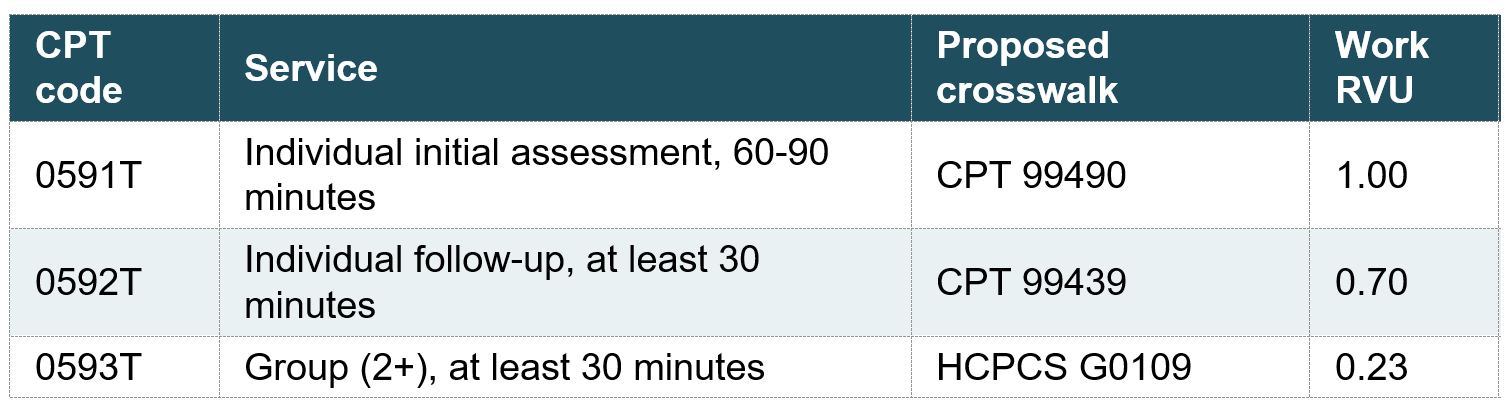
Alt text: A chart listing Health Coaching CPT codes and their proposed crosswalks/RVUs. For Code 0591T (Individual initial assessment, 60-90 minutes), the proposed crosswalk is CPT 99490 and the Work RVU is 1.00. For Code 0592T (Individual follow-up, at least 30 minutes), the proposed crosswalk is CPT 99439 and the Work RVU is 0.70. For Code 0593T (Group [2+], at least 30 minutes), the proposed crosswalk is HCPCS G0109 and the Work RVU is 0.23.
What Would Medicare Pay for Health Coaching?
For CY 2027, CMS proposes to crosswalk the work and direct practice-expense inputs for 0591T and 0592T to chronic care management codes 99490 and 99439, respectively. CMS proposes to crosswalk 0593T to HCPCS G0109 for group diabetes self-management training.
The proposed crosswalks do not guarantee the same total payment as the comparison codes. Final allowed amounts would reflect the complete PFS calculation, including work, practice-expense, and malpractice RVUs; the applicable CY 2027 conversion factor; geographic adjustments; and site of service.
The coding structure is also unsettled. CMS is soliciting comment on whether to create HCPCS G-codes for health coaching instead of actively pricing CPT Category III codes 0591T-0593T. Organizations should therefore avoid relying on the proposed codes, RVUs, or payment levels until CMS publishes the final rule.
How Does CMS Define “Health and Well-Being Coaching?”
CMS proposes to adopt the CPT prefatory language defining health and well-being coaching as a patient-centered process. Patients determine their own goals, use self-discovery or active learning together with education, self-monitor behaviors to increase accountability, and work with a qualified coach to build motivation and skills for sustainable change.
This definition should shape both program design and documentation. Generic education, reminders, care navigation, or one-directional clinical instructions may not demonstrate the collaborative, patient-directed coaching process contemplated by the code set.
Can Health Coaches Bill Medicare Independently?
No. The proposal does not establish health coaches as a new category of independently enrolled Medicare practitioner. It contemplates coaching performed by appropriately qualified auxiliary personnel under a Medicare billing practitioner's supervision.
Organizations should separately identify the person performing the coaching, the supervising practitioner, the Medicare-enrolled person or entity submitting the claim, and any community-based organization (CBO), staffing company, or digital health vendor employing or contracting with the coach. The arrangement should be evaluated under the final conditions of payment, applicable incident-to and reassignment rules, state scope-of-practice law, and federal fraud-and-abuse requirements.
What Qualifications Would Health Coaches Need?
CMS proposes appropriate certification or training for auxiliary personnel providing health coaching. Examples include:
Fulfillment of the National Board for Health and Wellness Coaching National Standards;
Eligibility under National Commission for Health Education Credentialing requirements for Certified Health Education Specialists;
Satisfaction of American Holistic Nurses Credentialing Corporation standards for Certified Nurse Coaches;
Training through qualifying evidence-based health-promotion and disease-prevention programs funded under the Older Americans Act and overseen by the Administration for Community Living.
CMS is soliciting comment on these certifications. General experience in wellness, nutrition, patient engagement, or care navigation should not be assumed to be sufficient for health coaching.
Will Medicare Health Coaching Require Supervision?
The proposed rule is not clear on the issue of supervision. CMS first states that 0591T-0593T may be performed under “direct supervision” of the billing practitioner under 42 C.F.R. § 410.26(a)(3). Under current Medicare policy, direct supervision may generally be satisfied through the supervising practitioner's real-time audio-and-video presence when virtual direct supervision is otherwise permitted; audio-only availability is not enough.
Later in the proposal, CMS states that individuals employed by qualifying CBOs may operate under “general supervision” if the proposed training and certification standards are met. General supervision does not require the billing practitioner to be present while the service is furnished.
A third statement in the proposed rule adds to the uncertainty. In explaining the valuation of 0591T and 0592T, CMS says those services, like chronic care management, are performed under “general supervision.” The final rule should clarify whether direct supervision is the default, whether general supervision is limited to the CBO pathway, or whether general supervision applies more broadly. Until then, organizations should not build a staffing or financial model that depends on general supervision outside the expressly described CBO pathway.
What is the CBO Pathway for Health Coaching?
The inclusion of CBOs in this proposal matters because CMS expressly states that qualified individuals employed by a CBO may operate under the “general supervision” of the Medicare billing practitioner if the proposed training and certification standards are met.
CMS describes CBOs as public or private not-for-profit entities that provide specific services to a community or targeted population to address that population's health needs. Examples include:
community care hubs
community-action agencies
housing agencies
area agencies on aging
centers for independent living
aging and disability resource centers, and
other nonprofits that receive grants or contract with healthcare entities to perform social services.
A for-profit coaching or digital health company would NOT qualify as a CBO.
Would Medicare Limit the Number of Coaching Sessions?
CMS is not proposing a fixed frequency limit because multiple sessions may be needed in the same calendar month. However this is not authorization for unlimited or automatically recurring billing. Each session would still need to be medically reasonable and necessary.
Documentation should support the beneficiary's health needs, the duration and content of the session, patient-selected goals, coaching methods, self-monitoring and accountability, progress and barriers, and why the service was reasonable and necessary. CMS states that it will monitor utilization and may revisit its policy.
How Could Health Coaching Impact Value-Based Care?
National payment for health coaching could give ACOs and other risk-bearing organizations another tool for chronic disease prevention and management, patient engagement, and sustainable lifestyle change. As proposed, health coaching may complement chronic care management, principal care management, behavioral health integration, community health integration, principal illness navigation, remote physiologic monitoring, and remote therapeutic monitoring, but it should not be assumed interchangeable with them.
How Should Healthcare Organizations Prepare for Health Coaches?
Audit workforce qualifications. Inventory coaching personnel and compare their education, training, certification, examination, and licensure with the proposed pathways.
Confirm the billing structure. Identify the Medicare-enrolled billing practitioner, the coach's employer or contractor, and the supervision model that would apply if the proposal is finalized.
Develop documentation standards. Capture patient-selected goals, coaching methods, education, self-monitoring, progress, barriers, session duration, and medical necessity.
Review vendor and CBO agreements. Address qualifications, supervision, record access, claims support, audits, data ownership, HIPAA obligations, compensation, and denied or recouped claims.
Model reimbursement conservatively. Account for changes to RVUs, supervision, coding, frequency policy, conversion factors, and the possibility that CMS does not finalize national payment.
Frequently Asked Questions
Is Medicare Health Coaching reimbursement final for 2027?
No. CMS has proposed national payment and conditions of payment, but the final rule may change or reject any part of the proposal.
When are comments on the Medicare Health Coaching proposal due?
Comments are due to CMS on September 14, 2026, and may be filed electronically.
Can a Health Coach bill Medicare independently?
No. The proposal does not create independent Medicare billing status for health coaches. A Medicare-enrolled physician or other eligible practitioner would bill for services performed under the applicable supervision and other conditions of payment.
Does CMS require direct or general supervision of Health Coaches?
The proposal is ambiguous. It references direct supervision, expressly permits general supervision for qualified CBO-employed personnel, and elsewhere characterizes 0591T and 0592T as generally supervised. CMS may clarify the policy in the final rule.
Can Medicare Health Coaching be furnished by telehealth?
CMS added 0591T-0593T to the Medicare Telehealth Services List beginning in CY 2024. Payment for a telehealth service still depends on the code's status for the date of service and satisfaction of all applicable coverage, practitioner, technology, location, and billing rules.
Are there proposed session limits for Health Coaching?
No fixed limit is proposed, but each service must be reasonable and necessary. CMS plans to monitor utilization.
Do the proposed crosswalks for Health Coaching guarantee payment equal to the comparison codes?
No. They inform proposed work and direct practice-expense inputs. Actual payment depends on the full PFS methodology and final policy.
Looking Ahead
The CY 2027 proposed rule could establish a more predictable Medicare payment pathway for qualified health coaching, but it leaves material operational questions about supervision, qualifications, coding, documentation, medical necessity, and overlap with existing services. Organizations should treat 2027 implementation as a proposed opportunity, not guaranteed revenue, and use the comment and pre-final-rule period to evaluate their workforce, care model, contracts, and compliance controls.
The Nixon Law Group team advises digital health companies, ACOs, and other healthcare innovators on Medicare reimbursement, care-delivery models, corporate structuring, commercial contracting, and fraud-and-abuse compliance. Contact us for assistance in drafting comments or to discuss how the proposed health-coaching policy could impact your organization.