
Remote Patient Monitoring stakeholders are breathing a sigh of relief – for now. The Centers for Medicare & Medicaid Services (CMS) has finalized significant changes to Remote Physiologic Monitoring (RPM) and Remote Therapeutic Monitoring (RTM) services and reimbursement in the Calendar Year (CY) 2027 Medicare Physician Fee Schedule (MPFS) Final Rule.
The most controversial of those changes, introduced in the July Proposed Rule, was a new requirement that clinical staff providing the monitoring and care management for RPM and RTM patients be employed by the medical practice ordering those services. To date, most medical practices have relied on vendors of RPM/RTM services to provide outsourced staff for monitoring. Those practices say that their own staff is already too busy to take on the care management aspects of RPM and RTM programs.
In response to a tsunami of comments from stakeholders, CMS has delayed the prohibition on third-party outsourced clinical staff to January 1, 2029 – hence, the sigh of relief.
The agency has also established new initiating visit requirements, extended the established-patient requirement to RTM, and finalized reductions in the valuation of several remote monitoring codes.
Taken together, these policies signal that CMS now expects RPM and RTM services to operate as clinically integrated extensions of the treating practitioner's practice, rather than as largely outsourced services supported by independent vendors. At the same time, CMS is reducing reimbursement for remote monitoring, potentially making it more difficult for providers to sustain the in-house clinical infrastructure that CMS now expects them to maintain.
Key Takeaways from the 2027 Final Rule
Third-party clinical staffing for monitoring and treatment management services will be prohibited beginning January 1, 2029. CMS will continue permitting contracted clinical staff through December 31, 2028.
RTM is now subject to an “established patient” requirement. This aligns RTM with the existing RPM requirement. An established patient is defined as a beneficiary who has received professional services from the billing practitioner (or another practitioner in the same group practice) within the previous 3 years.
New requirement for initiating visits begins January 1, 2027. Billing practitioners must discuss RPM or RTM with a patient during a separately reportable initiating visit, such as an E/M encounter or an Annual Wellness Visit, and must discuss RPM or RTM services during that visit. This may occur through telehealth.
CMS finalized reductions in the valuation of RPM and RTM services. Supply of Device valuations were reduced, though practice expense inputs for the treatment management codes were retained. Overall reductions (to the tune of 19%) will be phased in over multiple years.
CMS did not finalize bundled RPM and RTM G-codes. The existing coding structure remains in place, although future restructuring remains possible.
A deeper dive into RPM and RTM changes
1. The Biggest Challenge: Third-Party Clinical Staffing prohibition in 2029
Many remote monitoring companies currently offer turnkey programs for physician practices. Under these arrangements, vendors may provide monitoring devices, software platforms, patient onboarding, clinical monitoring, patient outreach, and treatment management support. Clinical personnel employed or contracted by the vendor perform these services under the billing practitioner's “general supervision.”
CMS has expressed growing concern that some of these arrangements lack sufficient clinical integration and practitioner oversight to satisfy the requirements for RPM and RTM reimbursement.
What CMS Finalized for 2029
Beginning January 1, 2029, clinical staff time used to furnish RPM or RTM services must be provided by individuals who are direct employees of the billing practitioner or the practitioner's practice. CMS states that contracting out clinical services to third-party companies will no longer be permitted for purposes of Medicare RPM and RTM billing.
In the Final Rule, the agency acknowledged that practices need time to hire personnel, establish internal workflows, and modify existing vendor arrangements in order to meet this requirement. CMS also committed to publishing subregulatory guidance to clarify permissible clinical staffing arrangements.
What Happens Between 2027 and 2029?
Until December 31, 2028, practices may continue using third-party clinical personnel, subject to existing incident-to and supervision rules. However, CMS specifically warns that, when the billing practitioner exercises insufficient oversight or the third-party clinical staff are not meaningfully integrated into the patient's care, the requirements for billing remote monitoring services may not be satisfied. Meaningful practitioner involvement will be expected.
Technology Vendors Can Continue Supporting RPM and RTM Programs
The staffing prohibition does not extend to all third-party vendor relationships.
CMS expressly recognizes that physician practices may continue purchasing or licensing technology and related services from outside companies, including:
Remote monitoring devices and software platforms;
Connectivity and data hosting;
Cybersecurity and interoperability services; and
Implementation and technical support.
In the future, companies offering both technology and clinical services may need to separate those functions or substantially restructure their offerings.
2. New Initiating Visit Requirements Beginning January 1, 2027
CMS has also finalized a new initiating visit requirement for both RPM and RTM services.
Beginning January 1, 2027, RPM and RTM must be initiated by the billing practitioner during a qualifying face-to-face encounter, either in person or through Medicare-covered telehealth. The purpose is to ensure that the practitioner evaluates the patient's clinical needs, determines whether remote monitoring is appropriate, and has an opportunity to obtain the required patient consent.
Several important clarifications emerged from the Final Rule:
The visit does not have to be dedicated exclusively to remote monitoring. RPM or RTM may be discussed during an otherwise qualifying office visit or telehealth encounter.
The initiating visit must occur before RPM or RTM billing begins. CMS did not establish a maximum permissible interval between the initiating visit and activation of monitoring.
The initiating visit does not necessarily have to generate separate payment. Although CMS initially proposed a separately reportable visit requirement, it clarified that the visit may qualify even when it is not separately billable in a particular circumstance.
Existing patients enrolled in RPM or RTM services before January 1, 2027, are grandfathered in. Beneficiaries already receiving remote monitoring before the new policy takes effect do not need another initiating visit merely to continue receiving services.
Routine changes do not automatically require another initiating visit. CMS identified device changes, clinical changes, and changes in billing practitioner within the same practice as examples that do not require a new visit. The initiating visit requirement also applies to patients aligned with Accountable Care Organizations (ACOs).
Telehealth is permitted. CMS permits initiating visits through telehealth when the applicable Medicare telehealth requirements are satisfied.
However, CMS notes that the statutory telehealth flexibilities currently extending through December 31, 2027, may expire absent further congressional action.
Operational Implications must be addressed. Practices and vendors should update their enrollment workflows to confirm that a qualifying initiating visit has occurred before monitoring begins.Clinical documentation should establish that the practitioner discussed RPM or RTM with the patient and determined that monitoring was clinically appropriate.
3. RTM Services for “Established Patients”
CMS has extended the established-patient requirement, previously applicable to RPM, to RTM services beginning January 1, 2027.
Generally, an established patient is someone who has received professional services from the practitioner, or another practitioner of the same specialty within the same group practice, during the preceding three years.
CMS noted distinct considerations for physical therapists, occupational therapists, and speech-language pathologists treating patients under an established therapy plan of care.
Importantly, CMS clarified that a beneficiary may become an established patient by completing the required initiating visit.
4. CMS Finalizes Reductions in RPM and RTM Reimbursement
The Final Rule also introduces substantial changes to the valuation of RPM and RTM services. The agency cited limited information about actual device costs and expressed concern that certain codes may be overvalued.
Remote monitoring vendors and medical practices have felt the pinch of reduced reimbursements for RPM and RTM over the last several years. But in the Final Rule, CMS questions whether existing reimbursement rates accurately reflect the costs of devices, software, clinical labor, and other resources used in remote monitoring programs. Most RPM stakeholders would agree that rates don’t accurately reflect costs – but they would argue that reimbursement is barely enough to cover costs.
Device Setup and Supply Codes
CMS finalized changes to the direct practice expense (PE) inputs for several RPM and RTM codes.
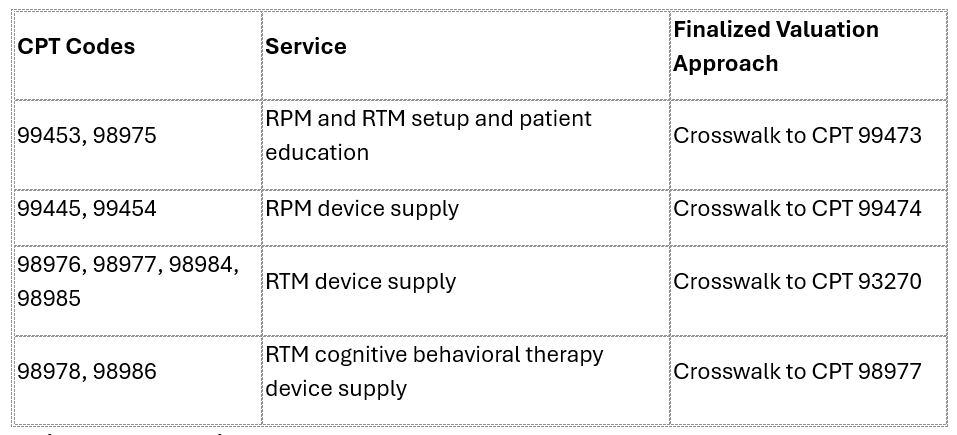
For CPT codes 99453 & 98975 (RPM and RTM setup and patient education), crosswalk to CPT 99473.
For CPT codes 99445 & 99454 (RPM device supply), crosswalk to CPT 99474.
For CPT codes 98976, 98977, 98984, & 98985 (RTM device supply), crosswalk to CPT 93270.
For CPT codes 98978 & 98986 (RTM cognitive behavioral therapy device supply), crosswalk to CPT 98977.
A Victory for Behavioral Health
CMS also finalized active pricing for CPT codes 98978 and 98986 beginning in 2027. These codes had previously been contractor priced, resulting in very low utilization.
The agency determined that these cognitive behavioral therapy monitoring codes should receive the same practice expense RVU as the comparable musculoskeletal RTM device supply code.
No reduction in Clinical Labor Inputs for Treatment Management services
CMS originally proposed eliminating direct practice expense inputs for six treatment management codes:
RPM: 99470, 99457, and 99458.
RTM: 98979, 98980, and 98981.
The agency reasoned that the resources associated with these services were already reflected in physician or qualified healthcare professional work RVUs. However, commenters explained that clinical staff frequently perform significant portions of remote monitoring treatment management. CMS agreed and declined to finalize the proposal.
5. CMS Declines to Adopt Bundled RPM and RTM Codes
CMS also considered a potentially significant restructuring of the remote monitoring code families. In the proposed rule, the agency solicited comments on replacing multiple existing RPM and RTM codes with four new HCPCS G-codes:
GRPM1: RPM setup and patient education.
GRPM2: Monthly RPM device supply and treatment management.
GRTM1: RTM setup and patient education.
GRTM2: Monthly RTM device supply and treatment management.
The proposed monthly codes would have combined device supply, data transmission, and treatment management into a single reimbursable service.
This approach was intended, in part, to address findings from the Department of Health and Human Services Office of Inspector General (OIG) that some Medicare beneficiaries receiving RPM did not receive all three components of remote monitoring: setup and education, device supply, and treatment management.
CMS ultimately did not finalize these bundled codes for 2027, indicating that it would consider stakeholder feedback in future rulemaking.
For now, providers may continue billing under the existing RPM and RTM code structures, subject to applicable requirements.
6. Increased Scrutiny of RPM and RTM Compliance
The Final Rule reflects CMS's continuing response to OIG findings concerning remote monitoring billing and oversight. Among the agency's concerns are arrangements involving unsolicited patient enrollment, insufficient practitioner involvement, and fragmented care delivery.
For providers and vendors, this reinforces the importance of maintaining clear documentation of medical necessity, practitioner oversight, patient consent, clinical interactions, and treatment management activities.
Looking Ahead: Remote Monitoring Is Entering a New Phase
For digital health companies, the next two years will be particularly important. Companies that anticipate challenges, adapt their service models, and demonstrate meaningful clinical integration will be better positioned to succeed.
Nixon Law Group advises digital health companies, remote monitoring vendors, healthcare providers, and investors on Medicare reimbursement, regulatory compliance, healthcare contracting, and innovative care delivery models. Our team works with organizations to evaluate RPM and RTM business models, structure compliant provider-vendor relationships, and navigate evolving federal and state healthcare requirements.
Frequently Asked Questions
Can RPM and RTM companies continue providing outsourced clinical staffing in 2027?
Yes. CMS will continue permitting third-party contracted clinical staffing through December 31, 2028, provided all existing Medicare billing, supervision, and other applicable requirements are satisfied. Beginning January 1, 2029, CMS's finalized direct-employment requirement takes effect.
Can physician practices still use third-party RPM and RTM technology platforms after 2028?
Yes. The finalized staffing restriction does not prohibit practices from obtaining monitoring devices, software, connectivity, data hosting, cybersecurity, or technical support from outside vendors.
Is an in-person visit required before starting RPM or RTM in 2027?
A qualifying face-to-face initiating visit is required, but it may occur through telehealth when Medicare telehealth rules permit. The practitioner must discuss RPM or RTM with the patient during that encounter.
Will existing RPM and RTM patients need another initiating visit in 2027?
No. Patients already receiving remote monitoring before January 1, 2027, do not need an additional initiating visit solely to continue services, provided all other requirements are met.
Did CMS eliminate the existing RPM and RTM CPT codes?
No. CMS considered replacing multiple codes with bundled HCPCS G-codes but did not finalize that proposal for 2027.